There are only three factors that contribute to profit: price, volume and cost. Hermann Simon has made this point for decades, and it is still the most useful sentence in management. Every strategy, initiative and transformation program eventually has to show up in one of those three, or it does not show up in profit at all.
The formula is simple:
Profit = (Price − Unit cost) × Volume − Fixed costs
The simplicity is exactly what makes it dangerous. Because it looks like three separate inputs, organizations treat it as three separate jobs.
The meeting
Picture a business-case meeting for a new product. Three functional leads, three slides, three confident faces.
The Product Lead presents the cost corridor: unit cost between €60 and €70. Under control.
The Marketing Lead presents the volume corridor: 80,000 to 100,000 units. Under control.
The Pricing Lead presents the price corridor: €95 to €110. Under control.
Everyone has done good work. Everyone has used ranges rather than false-precision point estimates, which is a mature habit. And everyone leaves the room believing the business case is solid.
Then someone asks the obvious question: and the profit?
Silence.
Three corridors that don’t exist on their own
The problem is not a lack of ownership. Every corridor has an owner. The problem is the illusion that the three corridors can be managed independently. They cannot, because each one quietly depends on the other two.
Price drives volume. Marketing’s 100,000 units almost certainly assumed a price near the bottom of the price corridor. At €110, the market will not deliver the same volume. That assumption is usually not written on any slide.
Volume drives cost. The Product Lead’s €60 unit cost assumes scale: purchasing leverage, utilization, learning effects. At 80,000 units, it is closer to €70.
Cost and value drive price. The features that justify a €110 price are often the same features that push unit cost to the top of its range. Cut them to hit €60, and the premium price loses its foundation.
Each corridor is internally consistent. Together, they contain combinations that cannot exist.
What the numbers look like
Take the three corridors above, plus €2 million in fixed costs. The numbers are illustrative; the pattern is not.
If you treat the corridors as independent, the profit corridor runs from zero (€95 price, €70 cost, 80,000 units) to €3 million (€110 price, €60 cost, 100,000 units). The midpoint case shows about €1.4 million.
Now look at the best case again. It assumes the highest price, the highest volume and the lowest cost at the same time. That is the one combination the market and the factory are least likely to allow. It is not an upside scenario. It is fiction assembled from three individually reasonable slides.
The coherent scenarios look very different:
Note that 75,000 units falls below Marketing’s own corridor, and at that volume €70 is optimistic. At €110, the corridors do not hold.
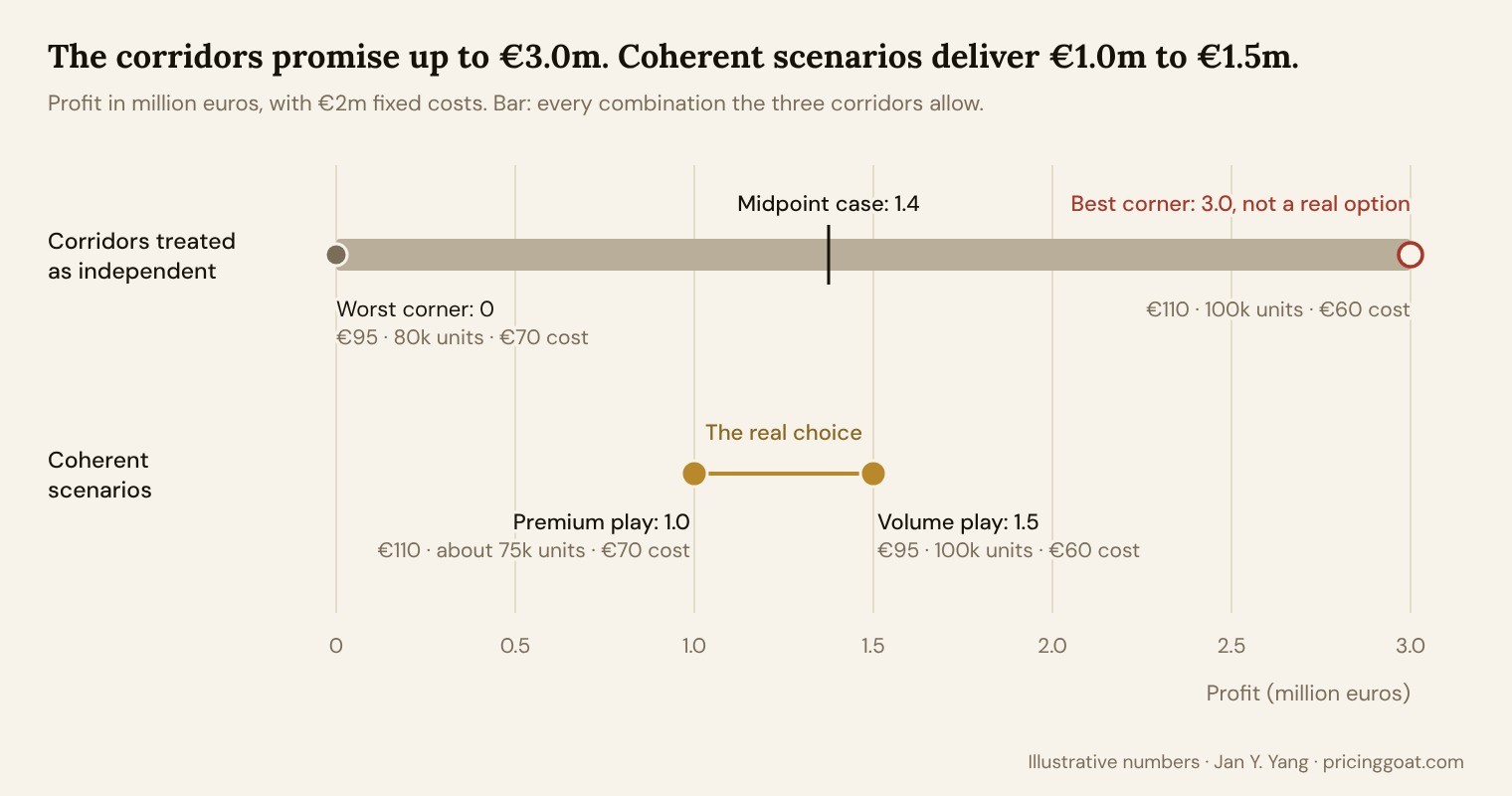
The real range is narrower, lower and, most importantly, it forces a choice. Volume play or premium play? That is the actual decision on the table. And it belongs to none of the three people who presented.
The organizational irony
Here is the irony. Each team feels in control of its own corridor, and in a narrow sense, it is. But nobody controls the interactions, and the interactions are what determine the profit.
Functional ownership rewards local confidence. The Product Lead is measured on cost, Marketing on volume, Pricing on price realization. Each can hit its target while the profit equation quietly falls apart between the slides. When the product later disappoints, every function can show that its own corridor held.
That is why “we need clearer ownership” is often the wrong diagnosis. Ownership is clear. It is just assigned to the parts instead of to the equation.
One equation, one business case
If the three drivers are coupled, the business case has to be built that way. Four practices make the difference:
Someone must own the profit corridor itself: not as a summary of other people’s slides, but as the place where trade-offs are decided.
Every corridor should state what it assumes about the other two. “100,000 units at a price of €95.” “€60 unit cost at 100,000 units with feature set B.” Hidden assumptions are where business cases go to die.
Replace “best case / worst case” built from extreme values with a small number of internally consistent strategic options. Each one is a story the market, the customer and the factory could all agree on.
Define the value and the target price first, then derive the target cost and the volume you can credibly win at that price. Cost-plus thinking runs the equation backwards and hands the most important decision to the function least equipped to make it.
Three drivers. One equation. No independent decisions. Otherwise you end up with the most familiar situation in business planning: everyone is in control. Except the profit.
not by default.
In your last business case, who owned the interactions between price, volume and cost? Or did they belong to the silence?
First published on LinkedIn, October 2026. Also available in Chinese: 人人有责,谁对利润负责?