Customers loved it. Nobody bought it.
Product-market fit explains the first sentence and says nothing about the second. A product can meet a real need in a real market and still fail commercially. In The Pricing Compass, I argued that the ultimate measure of product-market fit is price, and called the complete condition product-market-price fit: the right product, for the right segment, at a price, a price metric and a package that this segment will actually pay.
Most leaders I work with accept that definition quickly. Where we part ways is on how a company gets there.
The story of the lucky hit
Listen to how successful products are described afterwards. The timing was right. The market was ready. The price simply worked. Fit appears in these stories as something that happened, a fortunate alignment the team was smart enough to recognize.
Failures are told the same way in reverse. The market was not ready, the competitor moved first, and somewhere in the account the price was wrong.
Both stories share an assumption: that product-market-price fit is serendipity. Some products are blessed with it, others are not, and the best a company can do is test enough ideas to get lucky once.
I disagree. In my experience, fit is earned. It is the result of decisions, made deliberately and in the right order, and repeated for as long as the product is on the market.
Luck plays a part in every business. It should not be the method.
Fit is built, corner by corner
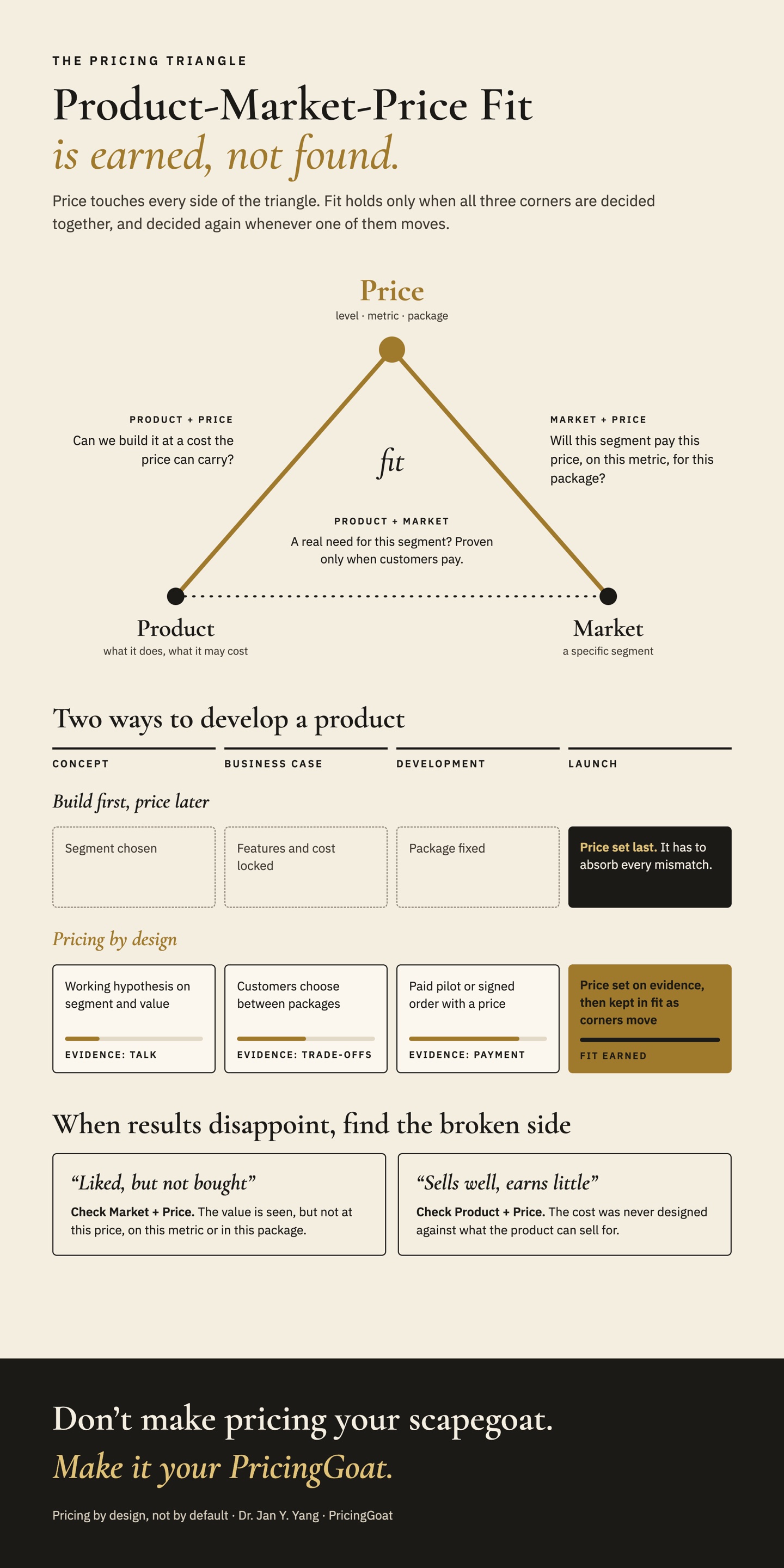
The reason fit can be earned lies in its structure. Picture product, market and price as the corners of a triangle. Fit is the state in which all of them hold together.
Every corner is a decision. Someone decides what the product does and what it may cost. Someone decides which segment it is for. Someone decides the price level, the metric and the package. Fit does not fall from the sky. It is the sum of these decisions, and it holds only when they are made with each other in view.
Price connects all of it. It shapes how the product is built, because what a product may cost follows from what it can sell for. It reflects how the market sees the product, because what customers will pay is their verdict on its value. And it proves that value at the one moment that counts, when a customer pays.
Because price is tied to both other corners, moving any corner moves the others. Add a feature, and cost rises, which changes the price you need, which may change who will buy. Aim at a new segment, and the acceptable price shifts, which changes what the product can afford to include. So fit is never earned once. Products change, markets change, and the triangle has to be brought back into shape each time. That is the hard part, and it is also why fit belongs to the companies that do the work.
Where luck takes over
Luck enters the picture through one familiar habit: build first, price later.
The decisions that determine what a product can earn are made early. Which customers it is built for, what it does, how it is packaged, what it may cost. When price is left out of those decisions, the product and the market corners are fixed before anyone asks what customers will pay. Whether the resulting price works is then, quite literally, a matter of chance.
I think of a new product that its CEO championed personally. It passed its business case review on conviction. Customers praised it. A year after launch, it had sold about half of its target.
When the numbers came in, the price was the obvious suspect. It was not the cause. The cause was that price had never been part of the decisions that shaped the product. By the time anyone set it, the product had already decided what it could earn.
This is the pattern I see most often.
Price is excluded from the work that creates fit, then blamed when fit fails to appear.
What the work looks like
Earning fit is not glamorous. It is ordinary discipline, applied early and kept up.
Price is treated as a question answered at every gate of product development. At the concept stage, the answer is a working hypothesis about segment and value. At each later gate, the evidence has to get stronger as customers are asked to commit more. Talk is the weakest evidence. Trade-offs are better, because when customers must choose between packages and give something up, their real priorities become visible. Payment is the strongest, whether a paid pilot or a signed order with a price on it. A project that cannot show stronger price evidence at this gate than at the last one has a problem, even if engineering is on schedule.
The pricing work runs as one continuous thread. In many companies it happens in separate efforts that each start from scratch, a value study early on and a pricing workshop shortly before launch, neither building on the other. Earning fit needs a single line of work from concept to launch, with someone accountable for it, where each step inherits what the previous one learned.
After launch, every change to one corner is handled as a change to the whole triangle. A new feature, a new segment or a cost increase is approved only once its effect on the other two corners is understood.
And when results disappoint, the triangle points to where the work was skipped. "Liked but not bought" points to the side between market and price: customers see the value, but not at this price, on this metric or in this package. "Sells well but earns little" points to the side between product and price: the cost was never designed against what the product can sell for. Either way, the answer is more work on a specific side, which is far more useful than waiting for better luck.
Scapegoat or PricingGoat
When a launch disappoints, pricing makes a convenient scapegoat. It is the last decision made, the most visible number, and the easiest one to change. Blaming it lets everyone else off the hook.
I would rather companies put pricing to work much earlier, as the sure-footed goat that climbs with the product from the first concept, checking every step, rather than the one sent into the desert when things go wrong.
Make it your PricingGoat.
Product-market-price fit is not a gift. It is earned, by pricing by design, not by default.
First published on LinkedIn, October 2026. Also available in Chinese: 客户都说好,就是没人买